- Joined
- Jan 7, 2025
- Messages
- 12
- Reaction score
- 2
Hello,
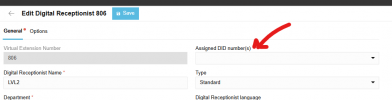
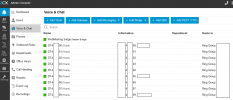
I've seen this issue on a lot of posts and have followed the suggestions but have not been able to get this to work. Currently we have 2 DiDs configured and 2 IVRs configured, incoming calls are ignoring the DiD rules and defaulting to the main IVR. I have triple checked with my VoIP provider who has been helping me troubeshoot the issue but so far no luck.
Trunk #: 902334xxxx
IVR1: 800
IVR2: 801
DID's:
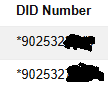
Log file shows the incoming call to the 2nd DiD which should route to IVR2 (801) it appears to get changed to the trunk number which does not match any DiD's and goes to the default IVR1 (800).
03/20/2025 3:28:30.978 PM [CM503012]: Inbound any hours rule (unnamed) for 10000 forwards to DN:800
03/20/2025 3:28:30.978 PM Rule matched
03/20/2025 3:28:30.978 PM Checking inbound rule '': hour type = 1; cond = 4; mask = ''
03/20/2025 3:28:30.978 PM Checking inbound rule '': hour type = 2; cond = 6; mask = '*902532xxxx'
03/20/2025 3:28:30.978 PM Checking inbound rule '': hour type = 2; cond = 6; mask = '*902532xxxx'
03/20/2025 3:28:30.978 PM [Flow] No office hours set, office hours assumed
03/20/2025 3:28:30.978 PM Current local time is: 15:28:30
03/20/2025 3:28:30.978 PM [Flow] Looking for inbound target: called=902334xxxx; caller="902349xxxx" <sip:902349xxxx@:0>
03/20/2025 3:28:30.978 PM CallerNameAddr: "902349xxxx"<sip:902349xxxx;nf=e>
03/20/2025 3:28:30.978 PM No inbound caller ID reformat rule for DN:10000 is defined, or it is disabled (<Rules />)
03/20/2025 3:28:30.978 PM Created device copy Dev(735382346):[sip:[email protected]:5060 / 902334xxxx]: AOR = <sip:[email protected]:5060/UDP>
03/20/2025 3:28:30.977 PM Source is identified as trunk Lc:10000(@DSMTel (AR)[<sip:[email protected]:5060/UDP>])
03/20/2025 3:28:30.977 PM Matched: User of RLine to 902334xxxx
03/20/2025 3:28:30.977 PM LineMgr: identifying the source of SIP request: SI Recv Req INVITE from 216.83.x.x:5060 tid=+86d17a09cc76238f339331e781036fbf1+sip+1+d22b6125 Call-ID=0gQAAC8WAAACBAAALxYAAL4WKnVCW3H9wWkvcIB2x38/[email protected]:
INVITE sip:[email protected]:5060;transport=udp SIP/2.0
Via: SIP/2.0/UDP 216.83.xx.xx:5060;branch=z9hG4bK+86d17a09cc76238f339331e781036fbf1+sip+1+d22b6125
Max-Forwards: 63
Contact: <sip:[email protected]:5060>;isup-oli=00
To: <sip:[email protected]>
From: <sip:[email protected]:5060>;tag=216.83.xx.xx+1+53a190a5+26917747;isup-oli=00
I know this is generally caused by the DiDs not matching what the provider is sending but they appear to match from the logs and what the provider tells me the format they are sending. I've tried with and without wildcard, with and without area code and country code but it never changes. Any help on this will be appreciated as this is causing grief for the customer.
I've seen this issue on a lot of posts and have followed the suggestions but have not been able to get this to work. Currently we have 2 DiDs configured and 2 IVRs configured, incoming calls are ignoring the DiD rules and defaulting to the main IVR. I have triple checked with my VoIP provider who has been helping me troubeshoot the issue but so far no luck.
Trunk #: 902334xxxx
IVR1: 800
IVR2: 801
DID's:
Log file shows the incoming call to the 2nd DiD which should route to IVR2 (801) it appears to get changed to the trunk number which does not match any DiD's and goes to the default IVR1 (800).
03/20/2025 3:28:30.978 PM [CM503012]: Inbound any hours rule (unnamed) for 10000 forwards to DN:800
03/20/2025 3:28:30.978 PM Rule matched
03/20/2025 3:28:30.978 PM Checking inbound rule '': hour type = 1; cond = 4; mask = ''
03/20/2025 3:28:30.978 PM Checking inbound rule '': hour type = 2; cond = 6; mask = '*902532xxxx'
03/20/2025 3:28:30.978 PM Checking inbound rule '': hour type = 2; cond = 6; mask = '*902532xxxx'
03/20/2025 3:28:30.978 PM [Flow] No office hours set, office hours assumed
03/20/2025 3:28:30.978 PM Current local time is: 15:28:30
03/20/2025 3:28:30.978 PM [Flow] Looking for inbound target: called=902334xxxx; caller="902349xxxx" <sip:902349xxxx@:0>
03/20/2025 3:28:30.978 PM CallerNameAddr: "902349xxxx"<sip:902349xxxx;nf=e>
03/20/2025 3:28:30.978 PM No inbound caller ID reformat rule for DN:10000 is defined, or it is disabled (<Rules />)
03/20/2025 3:28:30.978 PM Created device copy Dev(735382346):[sip:[email protected]:5060 / 902334xxxx]: AOR = <sip:[email protected]:5060/UDP>
03/20/2025 3:28:30.977 PM Source is identified as trunk Lc:10000(@DSMTel (AR)[<sip:[email protected]:5060/UDP>])
03/20/2025 3:28:30.977 PM Matched: User of RLine to 902334xxxx
03/20/2025 3:28:30.977 PM LineMgr: identifying the source of SIP request: SI Recv Req INVITE from 216.83.x.x:5060 tid=+86d17a09cc76238f339331e781036fbf1+sip+1+d22b6125 Call-ID=0gQAAC8WAAACBAAALxYAAL4WKnVCW3H9wWkvcIB2x38/[email protected]:
INVITE sip:[email protected]:5060;transport=udp SIP/2.0
Via: SIP/2.0/UDP 216.83.xx.xx:5060;branch=z9hG4bK+86d17a09cc76238f339331e781036fbf1+sip+1+d22b6125
Max-Forwards: 63
Contact: <sip:[email protected]:5060>;isup-oli=00
To: <sip:[email protected]>
From: <sip:[email protected]:5060>;tag=216.83.xx.xx+1+53a190a5+26917747;isup-oli=00
I know this is generally caused by the DiDs not matching what the provider is sending but they appear to match from the logs and what the provider tells me the format they are sending. I've tried with and without wildcard, with and without area code and country code but it never changes. Any help on this will be appreciated as this is causing grief for the customer.
Last edited: