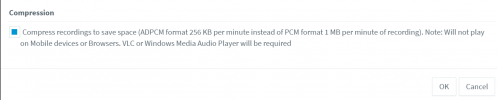
In previous forum posts 3CX staff noted various compatibility issues with some applications needing to play the audio, and OpenAI is yet another example of the problem. In the previous posts we were told that compression will not be returning in the future.
We took a different approach to the problem in our
3CX Recording Manager tool. We have separate retention policies for the original vs archived versions of the recordings. To explain how we handle this differently, let me offer an example. Let's suppose you have limited space on your 3CX server. Your goal is to keep the original recording around for a week or two, but you made the determination that after a couple of weeks the likelihood that someone will actually listen to a recording greatly diminishes.
With our tool, recordings are archived the second the call is completed. In the archive process, we compress the recording to 1/4 of the original size and we convert the file to a .MP3. This is a much more broadly supported format that handles compression well, and we chose the compression level based on the need to have no detectable degradation of the audio (you can increase the audio further if desired).
At the same time, we send the original recording to OpenAI to perform the transcription, summary, sentiment, ... AND .... any other AI questions you want. For example, you might want to perform agent scoring, or you might want to identify action items, or scheduled appointments, etc. There is no limit to what you can ask about your conversations with our tool.
But I digress... So, we have a retention policy for the original recording. This makes it possible to delete the original recording after perhaps two weeks. But what about the archive. Perhaps you have a regulatory requirement to keep recordings for 6 years. Our separate archive policy can automatically delete the archives too.
We address another challenge. In V18, you could be a manager of one group and a user in another. In V20 your role is global. That means if you are a manager, you are a manager for every department. We restrict access to recordings (in our web application) based on permissions YOU specify. So now, you control who's recordings a person can see, and you don't have to give any special 3CX console permissions.
I encourage you to take a look at our completely revamped version of Recording Manager. It has been rewritten from the ground-up to incorporate AI, with a new updated UI, and with significant performance improvements for people who have to manage millions of recordings.