- Joined
- Sep 17, 2021
- Messages
- 92
- Reaction score
- 114
Hello community,
Unfortunately, I have discovered that there seems to be no way to configure the caller ID display correctly on a mobile phone when call forwarding is enabled. I have tried various trunks and all the outgoing parameters that can be configured, but it appears to be an either-or situation.
Example A: In the trunk, the OriginatorCallerID is set for the "From: Display Name" or "P-Preferred Identity: Display Name" field.
When an external call comes in to an available extension with the aforementioned option enabled, both the desk phone and the mobile phone ring, and the original caller's number is displayed. Everything works perfectly. However, if an internal extension calls in this configuration, and the internal extension's direct line rings on both the desk phone and the mobile phone, the mobile phone only displays the trunk's main number, not the external or internal extension number of the caller. This is unfortunate because the employee using the mobile phone cannot see which colleague is calling.
Example B: In the trunk, "Outbound caller ID taken from Extension settings in management console" is set for the "From: Display Name" or "P-Preferred Identity: Display Name" field.
When an external call comes in to an available extension with this option enabled, both the desk phone and the mobile phone ring. In this scenario, the desk phone correctly displays the caller's number, but the mobile phone displays the external number of the called extension. Again, this is unfortunate because the employee using the mobile phone cannot see which external number is calling. However, when an internal extension calls in this configuration, and the internal extension's direct line rings on both the desk phone and the mobile phone, everything is displayed correctly.
Using the APP would be an option. Unfortunately not in Germany or other countries that dont have a stable mobile network. In my opinion, it would be appropriate to make an adjustment to the OriginatorCallerID parameter, which would populate it with the corresponding data depending on the origin (internal or external). It could either be filled with the external number of the internal extension being forwarded to the mobile phone, or with the number of the external caller being forwarded.
This would allow for better integration of mobile phones, especially in regions where the data network for using the app is really poor. Can anyone relate to this and consider such an adjustment useful? Or does anyone have an idea of how to implement this? It seems to me that even with a second trunk, this would be impossible.
Unfortunately, I have discovered that there seems to be no way to configure the caller ID display correctly on a mobile phone when call forwarding is enabled. I have tried various trunks and all the outgoing parameters that can be configured, but it appears to be an either-or situation.
Example A: In the trunk, the OriginatorCallerID is set for the "From: Display Name" or "P-Preferred Identity: Display Name" field.
When an external call comes in to an available extension with the aforementioned option enabled, both the desk phone and the mobile phone ring, and the original caller's number is displayed. Everything works perfectly. However, if an internal extension calls in this configuration, and the internal extension's direct line rings on both the desk phone and the mobile phone, the mobile phone only displays the trunk's main number, not the external or internal extension number of the caller. This is unfortunate because the employee using the mobile phone cannot see which colleague is calling.
Example B: In the trunk, "Outbound caller ID taken from Extension settings in management console" is set for the "From: Display Name" or "P-Preferred Identity: Display Name" field.
When an external call comes in to an available extension with this option enabled, both the desk phone and the mobile phone ring. In this scenario, the desk phone correctly displays the caller's number, but the mobile phone displays the external number of the called extension. Again, this is unfortunate because the employee using the mobile phone cannot see which external number is calling. However, when an internal extension calls in this configuration, and the internal extension's direct line rings on both the desk phone and the mobile phone, everything is displayed correctly.
Using the APP would be an option. Unfortunately not in Germany or other countries that dont have a stable mobile network. In my opinion, it would be appropriate to make an adjustment to the OriginatorCallerID parameter, which would populate it with the corresponding data depending on the origin (internal or external). It could either be filled with the external number of the internal extension being forwarded to the mobile phone, or with the number of the external caller being forwarded.
This would allow for better integration of mobile phones, especially in regions where the data network for using the app is really poor. Can anyone relate to this and consider such an adjustment useful? Or does anyone have an idea of how to implement this? It seems to me that even with a second trunk, this would be impossible.


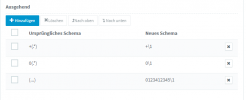
 ...) = 1 dot represents a position in the extension length.