Routing Incoming Calls Based on CID, multiple DID's

Status
Not open for further replies.

PFSRick

SOHO User
Joined
Jun 3, 2022
Messages
36
Reaction score
3
I have reviewed this webpage

https://www.3cx.com/docs/manual/inb... ID (CID) Inbound Rules,link to this CID rule.

although I have a few specific questions.

We have 5 DID numbers. If I create a CID inbound rule, will this rule apply to every call coming through the SIP trunk, or can I specify which DID numbers I want the rule to be applied to?

I have a specific use case I would like to implement, although I don't know if it will be possible. Here is my situation. We have 5 DID numbers, one of them is the general business line, the other 4 are direct lines to people within our organization. We have customers who call those direct lines, however, after business hours, I want to limit which callers can actually get through to us. Those not on our list, will only be able to leave a voicemail. I would rather not send those calls to a group or queue. I prefer to either let the call go through or force it to go straight to voicemail, depending on the caller ID.

I would appreciate any suggestions on ways I could handle this scenario.

Thanks in advance.
 
CID rules take precedence over DID rules, so they will work whatever the DID that was called.
 
Is there a way within 3CX that I can handle this situation as I described? Or will I have to send the calls through a group or queue?
 
The CID rule applies to the Sip Trunk and not for specific DID's.
So in this case you need to set a different destination for Out Of Office hours.
 
Thanks for the clarification on CID vs DID rules above. I also discovered that the order in which the rules are listed is also the priority of the rules. So, if a CID rule is listed below a DID rule, the DID rule will be applied first.

Does anyone else have suggestions on how to accomplish this workflow? We are on hosted v18, so we can't use CFD.

We have 5 DID numbers, one of them is the general business line, the other 4 are direct lines to people within our organization. We have customers who call those direct lines, however, after business hours, I want to limit which callers can actually get through to us. Those not on our list, will only be able to leave a voicemail. I would rather not send those calls to a group or queue. I prefer to either let the call go through or force it to go straight to voicemail, depending on the caller ID. Another variation to this is to force the caller to enter a code (ultimately an extension number), which would then connect them through to us. I don't like that option, but I can't seem to find any other solution. Also, we use SMS messaging on those 4 lines, so I want to keep that available, even after business hours.
 
Not sure why 3CX Hosted does not allow CFD, however, some folks have moved to Digital Ocean direct using the standard 3CX Distribution then you have to manage more of course but you get CFD back. The real question does this make sense is going to come with we move to v20 and have to deal with split-DNS and certs for every phone for VoIP encryption.
 
Just in case someone has a similar situation in the future, here is the solution we came up with:

Scenario:
We have 5 DID numbers, one of them is the general business line, the other 4 are direct lines to people within our organization. We have customers who call those direct lines, however, after business hours, I want to limit which callers can actually get through to us. Those not on our list, will only be able to leave a voicemail. I would rather not send those calls to a group or queue. I prefer to either let the call go through or force it to go straight to voicemail, depending on the caller ID. And we want the DID's to continue to be able to use SMS messaging to our customers, and be notified of the messages, even after hours.

Solution:
We setup the DID's to route to a digital receptionist for each user (4 users, 4 DR's). In the DR, we are forwarding the SMS to the appropriate "real" extension for the user. The other settings on the DR are set to just forward the incoming call within 1 second to a dummy extension for each user, again 4 users, 4 dummy extensions. In the DE, we are forwarding calls to the actual user. We have the DE set to change status with office hours so that calls after office hours go to the voicemail of the actual user. We are then adding exceptions for any customer we want to allow to contact us after hours in the exception list of the DE and forwarding those calls on to the actual user. This has worked so far for about a week with no observed ill effects.

I do not like this solution and yes, it would be impossible to implement if we had more users, however, this is the only way I found to accomplish the above scenario. If anyone sees this and thinks this will cause issues down the road, please let me know, otherwise, this is our plan forward for the year. I am hoping none of the changes in v20 will cause us issues down the road when we update.
 
If anyone sees this and thinks this will cause issues down the road, please let me know, otherwise, this is our plan forward for the year. I am hoping none of the changes in v20 will cause us issues down the road when we update.
You will probably need to make adjustments to this configuration when you get to V20 but it will probably be easier to configure in V20. You can get rid of the dummy extensions since Digital receptionists in V20 can forward calls based on office hours.
For the customers you want to go through you can use CID rules.
 
  • Like
Reactions: Evolute IT
Just in case someone has a similar situation in the future, here is the solution we came up with:

Scenario:
We have 5 DID numbers, one of them is the general business line, the other 4 are direct lines to people within our organization. We have customers who call those direct lines, however, after business hours, I want to limit which callers can actually get through to us. Those not on our list, will only be able to leave a voicemail. I would rather not send those calls to a group or queue. I prefer to either let the call go through or force it to go straight to voicemail, depending on the caller ID. And we want the DID's to continue to be able to use SMS messaging to our customers, and be notified of the messages, even after hours.

Solution:
We setup the DID's to route to a digital receptionist for each user (4 users, 4 DR's). In the DR, we are forwarding the SMS to the appropriate "real" extension for the user. The other settings on the DR are set to just forward the incoming call within 1 second to a dummy extension for each user, again 4 users, 4 dummy extensions. In the DE, we are forwarding calls to the actual user. We have the DE set to change status with office hours so that calls after office hours go to the voicemail of the actual user. We are then adding exceptions for any customer we want to allow to contact us after hours in the exception list of the DE and forwarding those calls on to the actual user. This has worked so far for about a week with no observed ill effects.

I do not like this solution and yes, it would be impossible to implement if we had more users, however, this is the only way I found to accomplish the above scenario. If anyone sees this and thinks this will cause issues down the road, please let me know, otherwise, this is our plan forward for the year. I am hoping none of the changes in v20 will cause us issues down the road when we update.
Can we adapt your workaround to use it this way :

We need to redirect a call based on the caller id, to a specific ring group / digital receptionist etc because this caller speaks another language so we need him to be greeted with the appropriate prompts.
 
@FREEEEMAN is there a specific pattern of the incoming numbers?
If so you can create a CID Rule to route those calls accordingly.
 
  • Like
Reactions: Evolute IT
@FREEEEMAN is there a specific pattern of the incoming numbers?
If so you can create a CID Rule to route those calls accordingly.
It would be just one specific calling number. Also, not sure if can be done on the free tier -the CID rules-, thats why was asking for another way than CID rules...
 
I mean CID rule in the PBX. Do you know the caller id that comes in the PBX?
 
I mean CID rule in the PBX. Do you know the caller id that comes in the PBX?
Yes, I know the specific phone number that needs to be forwarded to distinct IVR / DI etc; it s a french landline starting by 0030186XXXX.
 
Are you in an SMB installation?
 
As I mentioned earlier, it s the free tier 3CX, thats why I was asking about eventually adapting PFSRick workaround, if doable, to route a specific incoming call number. Or with another way, if such thing can be done.
 
For the SMB this is not an option and the solution that was asked is for 3CX Hosted or self hosted installation.
 
Sadly, that"s what I thought; but wanted to be sure.
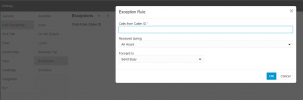
Is there no method with the call forwarding into user settings and the exception option with caller id ?
 
You can set the exception to an extension but note that you need to route all calls to this extension:
1713325690125.png
 
@FREEEEMAN I am not familiar with the different options available with the different 3CX accounts, but as @TheodorosG_3CX has said, I think if you are sending all of the calls through one extension (dummy extension or real extension) then you could create an exception for that one inbound number and send it to another extension.
 
  • Like
Reactions: TheodorosG_3CX
That is correct, try and test this option and let us know the outcome.
 
Status
Not open for further replies.

Members Online Now

Forum statistics

Threads
111,835
Messages
589,291
Members
164,668
Latest member
Infinity Network