



Help customers move beyond ageing phone systems and turn PBX migrations into new business opportunities.
Many businesses still rely on traditional phone systems that were installed years ago. These systems may continue to handle calls, but the way people work has changed. Employees work from different locations, customers expect faster responses and businesses want their communications connected to other applications.
For 3CX Partners, this creates a clear sales opportunity. Rather than waiting for a customer’s phone system to fail, start a conversation about what their current system can no longer deliver. A PBX migration is more than a hardware replacement. It is an opportunity to improve business communications, introduce new capabilities and build a long-term customer relationship.
Here is how to identify migration opportunities, demonstrate the value of 3CX and turn an ageing PBX into new business.
Find the Right Migration Opportunities
Many customers are comfortable with their existing systems because they still work. The challenge is helping them recognise the limitations they have learned to live with. Start by looking for businesses facing one or more of these situations:
- Ageing hardware: Replacement parts, maintenance and specialist support are becoming harder to obtain.
- Limited flexibility: Adding users, changing call flows or connecting remote employees requires extra hardware or technical work.
- High operating costs: Maintenance contracts, proprietary licences and separate communication services increase costs.
- Limited integration: The phone system operates separately from CRM, reporting and other business applications.
- Changing business needs: The company is expanding, opening new locations or introducing hybrid working.
- Limited visibility: Managers lack useful information about missed calls, customer demand and employee availability.
These are natural starting points for a sales conversation. A customer may not be interested in replacing a working PBX. However, they may be interested in reducing maintenance costs, improving customer service or giving employees more flexibility.
Sell the reason to change before selling the replacement system.
Ask Questions That Reveal Business Needs
A good migration conversation starts with questions, not a product demonstration. Ask customers how their current system supports their daily operations. For example:
- What happens when employees need to work remotely?
- How easily can you add users or open another location?
- Can your phone system connect to your CRM?
- Do you know how many customer calls go unanswered?
- How much time does your team spend managing the system?
- What happens if your current PBX fails?
The answers can reveal opportunities that go beyond basic telephony. They also help you understand which 3CX features will deliver the most value. That makes your proposal more relevant and gives customers a stronger reason to consider migration.
Show Customers What They Gain With 3CX
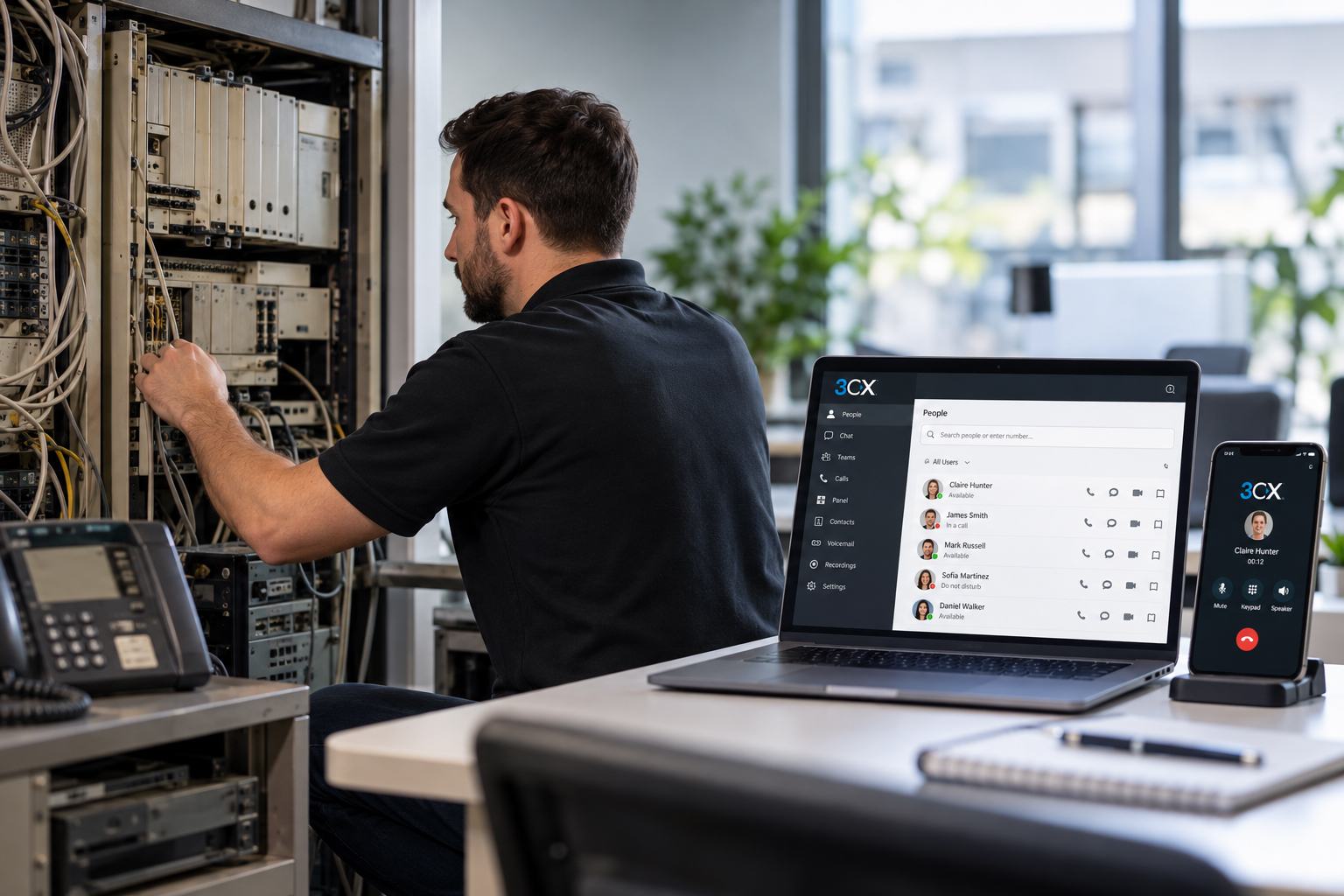
Replacing a traditional PBX should not mean exchanging one phone system for another. Customers need to understand what improves after the migration.
With 3CX, businesses can bring calling, messaging, video meetings and customer communications together in one platform. Employees can communicate from their desk, computer or smartphone, while administrators manage the system centrally.
Depending on the edition and deployment, customers can also benefit from:
- Flexible working: Use desktop and mobile apps to stay connected across locations.
- CRM integration: Connect calls and customer information to existing business applications.
- Call queues and reporting: Improve call handling and gain insight into customer demand.
- AI capabilities: Introduce transcription, call summaries and AI Agents to support customer interactions.
- Deployment flexibility: Choose a supported hosted, cloud or self-managed deployment.
- Scalable licensing: Size the system around simultaneous calls rather than paying for every individual user.
The goal is not to demonstrate every feature. Focus on the improvements that matter to the customer. For a small professional services company, this might mean fewer missed calls and easier remote working. For a larger organisation, it could mean better reporting, CRM integration and more efficient customer service.
Make the Business Case, Not Just the Price Comparison
Price matters, but comparing licence costs alone rarely tells the full story. A traditional PBX may involve hardware maintenance, proprietary expansion modules, support contracts and separate services. A modern communications platform can simplify parts of that environment and reduce the effort required to manage it.
Review the customer’s current costs and compare them with the proposed 3CX deployment. Include licensing, hosting, connectivity, compatible hardware, implementation and ongoing support.Also consider the value of capabilities the customer does not currently have.
A successful migration should improve the way a business communicates, not simply reduce its telephone bill.
Use a Trial to Build Confidence
Customers may recognise the benefits of a modern PBX and still hesitate to replace a system they depend on every day. Their concerns are understandable. Will existing phone numbers work? Can employees adapt? What happens to call routing? Will the new system integrate with their existing applications?
A structured evaluation can answer these questions before the customer commits to a full migration. Check out our blog about using trials on how to build and convert customer systems. Use it to build a working example of the customer’s future communications environment.
Create a Practical Migration Plan
A simple migration process helps customers understand what will happen and reduces uncertainty.
- Assess the existing environment: Document users, phone numbers, SIP trunks, call flows, devices, locations and integrations. Identify any functions that require special attention.
- Define the new requirements: Determine which existing functions must be retained and where 3CX can improve the customer’s workflow. Check hardware and provider compatibility before making commitments.
- Build and test the proposed system: Use a 3CX trial to configure call routing, extensions, queues and relevant integrations. Let key users experience the new system.
- Plan the transition: Agree on number porting, user training, deployment responsibilities and a suitable migration window. Prepare a fallback plan for critical communications.
- Review the deployment: After migration, check call handling, user adoption and system performance. Identify additional opportunities once the customer is comfortable with the new platform.
This approach gives customers greater confidence. It also helps Partners identify potential issues early, before they affect daily operations.
Turn a Migration Into a Long-Term Relationship
The initial migration is only the beginning. Once a customer moves to 3CX, they will continue to need connectivity, hosting, system management, updates and support. Their requirements may also change as the business grows. That creates opportunities to introduce additional services over time, including CRM integrations, advanced reporting, contact centre functionality and AI.
Instead of treating migration as a one-time project, build an ongoing managed communications service around the customer’s needs. This follows the same principle explored in our blog about building recurring revenue around 3CX. The licence creates the starting point, while your expertise and services deliver value throughout the customer relationship.
For Partners, the opportunity is significant. Every ageing PBX represents a potential conversation about improving communications. Some customers will be ready to migrate immediately. Others may need time, a demonstration or a clear business case. The important step is to start that conversation.
Find customers whose phone systems are holding them back. Show them what modern communications can deliver. Then use 3CX to turn that opportunity into a lasting business relationship.




 Copyright © 2026