


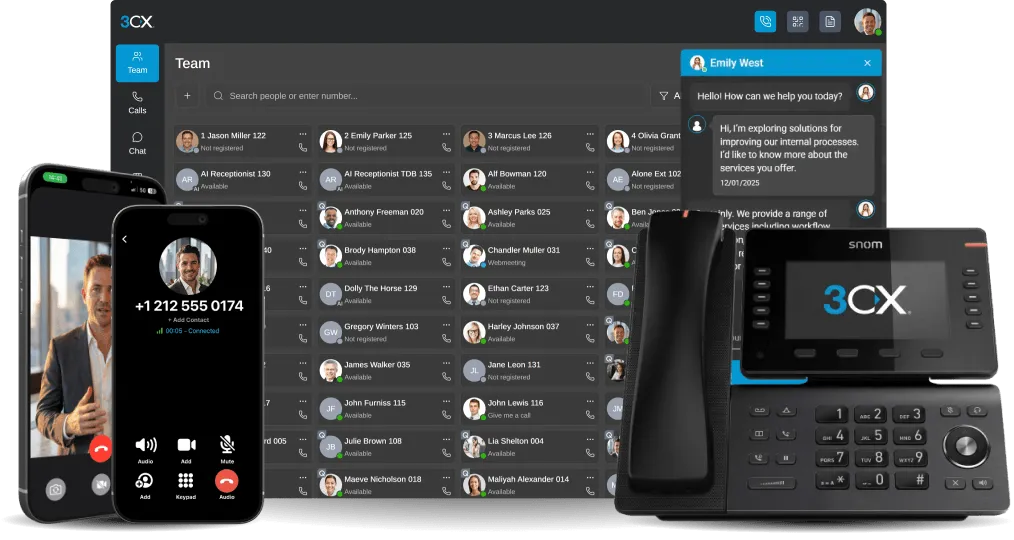


Turn technical capabilities into compelling business reasons for customers to choose 3CX.
Customers rarely start looking for a new communications system because they want better call queues, CRM integration or AI features. They usually have a business problem they want to solve.
Perhaps their sales team misses too many calls. Customer service employees spend too much time handling repetitive enquiries. Or managing communications across several locations has become increasingly complicated. These are the challenges that drive purchasing decisions. Yet conversations about business communications can quickly become discussions about features, licences and technical specifications.
The strongest sales conversations start with business problems, not product features.
Understand the Problem Before Presenting the Solution
A customer asking for a new phone system may already have a solution in mind. They might request a certain number of extensions, mobile applications or specific call handling features. However, these requirements do not always explain why the customer wants to make a change.
A company requesting more extensions may actually be struggling with business growth. Another asking about call recording may need better visibility into customer interactions. A business interested in AI might simply want to reduce the time employees spend answering routine questions. Understanding the reason behind the request helps you recommend a solution that delivers meaningful value.
Ask Questions That Reveal Business Needs
Before presenting 3CX, take time to understand how communications affect the customer's daily operations.
Consider asking questions such as:
- What communication challenges are affecting your business today?
- How do missed calls impact your sales or customer service?
- Are employees spending too much time switching between applications?
- How do you measure the performance of your customer-facing teams?
- What happens when call volumes increase unexpectedly?
- Which communication processes would you like to improve or automate?
These questions encourage customers to describe their challenges rather than simply list technical requirements. They also help identify priorities. A customer focused on reducing operational costs may value different capabilities from one trying to improve customer satisfaction.
Once you understand the problem, you can explain how 3CX contributes to the solution.
Translate 3CX Features Into Business Value

Technical features are important, but customers need to understand what those capabilities mean for their business. For example, telling a customer that 3CX supports call queues explains a function. Explaining how queues can help distribute incoming calls and reduce missed customer opportunities communicates a potential business benefit. The same principle applies to CRM integration, reporting, mobile applications and AI. Instead of presenting features individually, connect each capability to a challenge the customer recognises.
Connect Capabilities to Customer Outcomes
These examples illustrate how Partners can turn technical conversations into business discussions.
| 3CX capability | Customer challenge | Potential business outcome |
|---|---|---|
| Call queues | Incoming calls are not handled efficiently | Better call distribution and fewer missed opportunities |
| CRM integration | Employees manually search for customer information | Faster access to customer records and less manual work |
| AI Agents | Teams repeatedly answer similar enquiries | More efficient handling of routine customer interactions |
| Call reporting and analytics | Managers lack visibility into call activity | Better insight into demand and team performance |
| Desktop and mobile apps | Employees work across different locations | Greater flexibility and more consistent accessibility |
| Hosted 3CX | Internal IT resources are limited | Less infrastructure to maintain internally |
| Call transcription and summaries | Important information from conversations is difficult to capture | Easier follow-up and better access to conversation details |
The goal is not to promise that every feature will automatically deliver these results. Actual benefits depend on the customer's environment, workflows and implementation. Instead, use these examples to explain what improvements may be possible and how they relate to the customer's priorities. The relevant functionality also depends on the 3CX edition and licensing selected.
Make the Benefits Relevant to Each Customer
The same 3CX capability can deliver different benefits depending on the organisation. Consider CRM integration:
- For a sales team, it may help employees recognise returning customers and access relevant information before answering questions.
- For a customer service department, it could reduce the time spent searching for previous interactions.
- For management, better integration between communications and business applications may help create more consistent workflows.
The technology remains the same. The value changes depending on who uses it and what they need to accomplish. This is why a generic feature presentation is rarely as effective as a conversation built around the customer's own situation.
Build a Business Case Customers Can Understand
Once you have connected customer challenges to relevant 3CX capabilities, the next step is explaining why the improvement is worth investing in. Customers often compare solutions based on licensing costs and implementation expenses. However, price alone does not reflect the potential value of a communications solution.
Time spent on manual processes, missed customer enquiries and inefficient call handling can also affect business performance. Partners who help customers understand these factors can move the discussion beyond the initial purchase price.
Use Practical Examples Instead of Technical Claims
Imagine a customer service team handling hundreds of calls every week. Employees frequently answer the same questions about opening hours, order status or basic service information. Meanwhile, more complex enquiries compete for their attention.
Rather than immediately demonstrating every available AI feature, start by examining the workload. How many enquiries are repetitive? How much employee time do they consume? Which questions could be handled automatically without compromising service quality?
An AI Customer Service Agent may be suitable for selected interactions, while more complex requests continue to reach employees. A limited pilot can help establish whether the approach delivers measurable benefits before expanding the deployment. Another customer may be concerned about missed sales calls. Reviewing call activity and identifying busy periods could reveal opportunities to improve routing, staffing or queue configuration.
These examples create a stronger business case because they connect the proposed solution to a problem the customer already understands.
Help Customers Evaluate the Investment
Not every business case needs a complex financial model. Start with a few practical questions:
- How much employee time could the improvement save?
- Could it reduce missed calls or improve response times?
- Would it make customer information easier to access?
- Could it reduce the amount of manual administration?
- What implementation, training or ongoing service costs are involved?
- How will the customer measure whether the change is successful?
Where possible, establish a baseline before introducing new functionality. For example, measure current missed calls, average handling times or the volume of repetitive enquiries. Review those figures after implementation to understand what has improved. Avoid presenting estimated savings as guaranteed results. Use realistic assumptions and explain what needs to happen for the customer to achieve the expected benefits.
A convincing business case shows customers what they are investing in, what they can reasonably expect and how success will be measured.
Make Business Outcomes Part of Your Sales Process
Selling business value should not be limited to one presentation or meeting. It should become part of the way you qualify prospects, demonstrate 3CX and develop existing customer relationships. A consistent approach also makes it easier to identify opportunities for additional services.
Demonstrate Solutions, Not Feature Lists
A successful 3CX demonstration does not need to cover every available capability. Instead, select a few scenarios that reflect the customer's actual challenges. If a prospect struggles with incoming call management, demonstrate how calls can be routed to the appropriate team and how managers can review call activity. If employees spend too much time switching between systems, show how CRM integration can simplify their workflow.
For a customer interested in AI, demonstrate a realistic use case rather than presenting AI as a technology that solves every problem. Keep the demonstration focused on the business process before and after the proposed improvement. This helps customers picture how the solution would work in their own organisation.
Create Opportunities Beyond the Initial Deployment
A business-focused sales approach also creates opportunities after the initial 3CX installation. Customer needs evolve. Teams grow, applications change and new communication challenges emerge.
As discussed in our article on finding growth opportunities among existing 3CX customers, regular reviews can help Partners identify where additional capabilities or services may deliver value. A customer who initially needed basic business telephony may later benefit from CRM integration, advanced reporting or AI.
Others may require additional training, configuration changes, managed hosting or ongoing support. These opportunities can generate project revenue and create recurring service relationships. Our article on building recurring revenue around 3CX explores how Partners can develop services beyond the licence itself.
The important point is to keep the conversation focused on the customer's evolving requirements rather than simply promoting additional features.
Sell the Value, Not Just the Technology
3CX provides Partners with a broad range of communications capabilities. However, technology alone rarely makes the strongest sales argument. Customers want to know how a solution will help their business operate more effectively, serve customers better or address challenges that are costing them time and resources.
Partners who understand those priorities can recommend more relevant solutions, deliver more convincing demonstrations and build stronger business cases. This approach can also create longer-term opportunities. When customers recognise the value of your advice, you become more than the company supplying their communications system. You become a Partner who helps improve the way their business operates.
Not every conversation will lead to an immediate sale. Some customers may need time to evaluate their options or may not require additional functionality. However, focusing on business outcomes builds trust and gives customers a clearer reason to invest when the time is right.
Don't start your next sales conversation by explaining what 3CX can do. Start by asking what your customer wants to achieve, then show them how 3CX can help them get there.







 Copyright © 2026