


What are SIP Phones?
Simply put, a SIP Phone is a phone that uses the Open Standard "SIP" to set up and manage phone calls. The actual voice is carried over an IP-based network using another Open Standard called "RTP".
Since these protocols are generically termed "VoIP" (voice-over-internet-protocol), these phones are also sometimes called VoIP Phones, VoIP Clients or IP Phones.
SIP Phones can be classified in 2 main categories:
Hardphones / Deskphones
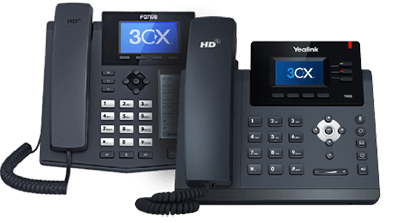
A hardphone looks like a regular telephone and indeed behaves like one. However, the hardware is built using network-aware, or more specifically, IP-aware components. The hardphone will connect to an IP-Network using regular ethernet cables or using WiFi. Cordless hardphones are also available, and these devices take another industry-standard cordless technology called DECT, so that the phones communicate with a base station using the DECT protocol, while the base station communicates with an IP-PBX using SIP and RTP as their transport protocols.
Softphones
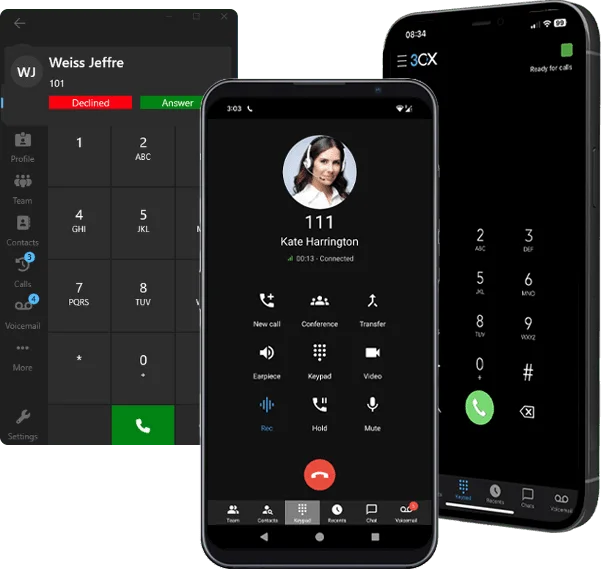
A Softphone is quite simply what its name implies – a software program that provides IP telephony functionality. Again, a softphone will, just like a hardphone, use the Open Standards protocols SIP and RTP for call setup and voice delivery. Any computing device such as:
…can run softphone programs, providing a very wide array of options from which to choose. Any computer or smart device that has a microphone and speakers (or a headset) can double up as a softphone. The only prerequisite is an IP-based connection to a VoIP Provider or a SIP Server, often in the form of an IP-PBX.
What are the benefits of a softphone?
Using a softphone allows us to make better use of computing resources, but a more important benefit is actually the fact that it is software-based. Being software-based means that the softphone receives regular updates, ensuring ongoing security and reliablity. Softphones can be integrated with other systems such as CRM systems to help further improve team productivity.
3CX can be used with most popular hardware IP Phones, but also comes with a completely FREE software-based SIP Phone, with extended functions that are not possible to achieve with a hardphone:
Softphones allow for integration with CRM systems, enabling agents to access customer data directly during calls. They also offer mobility, as they can be used on smartphones, tablets, or laptops, allowing users to make and receive calls from anywhere with an internet connection. Finally, softphones support instant messaging, video conferencing, and file sharing within the same interface, creating a unified communication experience.
Choosing a SIP phone service provider
When choosing a SIP phone service provider, businesses should ask themselves the following key questions:
- Does the hardware SIP Phone work seamlessly with your phone system?
Ensure that the SIP Phone you choose - in the case of a hardphone or deskphone - works seamlessly with your IP PBX. Most PBX vendors have supported IP Phones which plug ‘n’ play with the phone system. - Is the provider cost-efficient?
Consider whether the provider offers a pricing structure that aligns with your budget while providing the features your business needs. - How flexible is the service?
Ensure the provider offers scalability and adaptability to grow with your business and accommodate changing communication needs. - Does the provider prioritize data security?
Verify that the provider has robust encryption and security protocols to protect sensitive communications. - What level of customer support is offered?
Opt for a provider with 24/7 customer support, ensuring quick resolutions to any issues.
Choosing 3CX ensures cost-effective, secure, and flexible solutions backed by world-class support.
Your questions answered…
We’ve answered key questions about SIP Phones and their function.
Further reading
Last Updated
This document was last updated on 4 July 2025
https://www.3cx.com/pbx/sip-phones/

 Copyright © 2026