


If you are using a VoIP provider, you will need to have a firewall that supports and is configured to use static port mapping. Static port mapping is required for RTP, the protocol that carries audio, to be able to function correctly. RTP and Symmetric NAT VoIP applications that use the RTP protocol to send and receive audio and video streams, tend to have problems behind a fir [...]
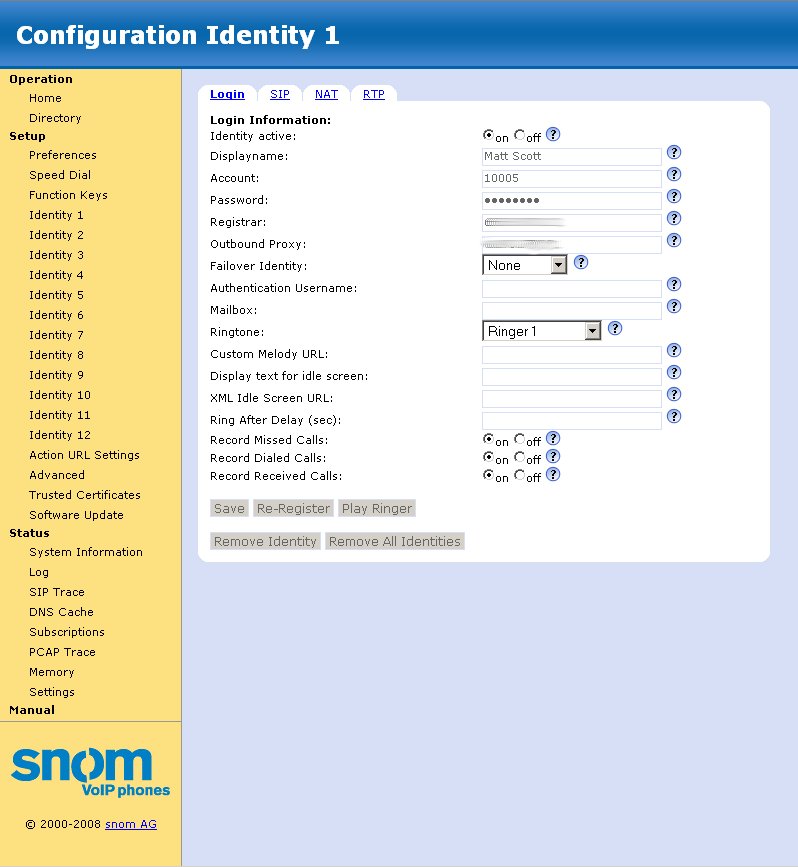
Important Notice: This article is not currently maintained and is here for archival/informational purposes. This procedure is outdated. I want to start off by giving credit on this nice little piece of engineering to Worksighted systems engineer Matt Scott. I want to start off by defining a remote extension as one that must exit a NAT boundary to traverse the Internet before co [...]
Overlap dialing is required by CAS signaled lines. Overlap dial provides for a longer time-out period between digits, also called the inter-digit timer. With overlap dial set to off, the gateway expects to receive the digits one right after the other coming in to this line with very little delay between digits. With overlap dial set to on, then the device waits up to about 2 se [...]
In the VoIP / telecommunications field, the term QoS (Quality of Service) refers to resource reservation control mechanisms. Quality of service is the ability to provide different priority to different applications, users, or data flows, or to guarantee a certain level of performance to a data flow. Quality of service guarantees are important for VoIP since VoIP is real time [...]

To troubleshoot or analyze a particular problem, it is often handy to take a closer look at the actual SIP traffic being sent to and from 3CX Phone System or the 3CX client. For example: You can check whether SIP traffic is arriving at the server, and thus verify that traffic is not blocked by a firewall on the client or by a firewall sitting in between the server and the VOIP [...]
STUN resolution is necessary for the PBX to understand what it's public IP Address is, and what port mappings are in effect for Media (to attempt NAT traversal when port forwarding is not implemented). STUN resolution may be disabled when: No External entities are in use (no bridges, voip providers, extensions) AND/OR Static Port Forwarding is in place for reliable media exchan [...]
Call Progress tones are audible tones used by the public switched telephone network (PSTN) central office or a private branch exchange (PBX) to signal calling parties the status of phone calls. VoIP Gateways must understand these Call Progress Tones in order to detect a busy tone, dial tone or hangup correctly. Unfortunately these Call Progress Tones can vary per country, and i [...]
One of my favorite things about 3CX is that it is so easy to get creative about how we leverage the great features the product has to offer. It never ceases to amaze me how I can build some fairly complex call handling logic using just a handful of basic features built on each other in succession. A few simple features, when combined, give us a whole new function we hadn’t thou [...]
STUN stands for Simple Traversal of User Datagram Protocol (UDP) through Network Address Translators (NAT's). It is used in several different network implementations and scenarios, one of which is VoIP. Because of the way protocols used in a SIP based VoIP call work, making calls between two SIP entities running behind NAT devices such as a router or firewall, users typically e [...]
As many of you probably do, I use Vonage service at my home over my cable Internet connection. The other night as I was sitting downstairs trying to convince my 1 month old to go to bed when I began to wonder, "how does Vonage manage to make it so easy to connect my home phone to their service?". I was especially curious when I considered that no router changes on my home net [...]

 Copyright © 2026