Overflow Call Queues

Status
Not open for further replies.

jskinner97

Bronze Partner
Intermediate Cert.
Joined
Feb 6, 2020
Messages
132
Reaction score
8
Hi all,

I currently have some overflows setup, so if nobody answers support queue within 20 seconds it will go to another queue that will ring all agents, however it then counts as an abandoned call on the original queue.... this is not good for reporting as we do not know how many are true abandoned calls.

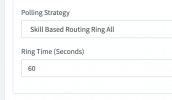
I then tried to do it based on Skill Based Routing - Ring All. I set first line agents to Skill Level 1 - so it rings then first, then ring agents with Skill Level 2, however this does not work.. it works if all agents in the skill level 1 are busy thought.
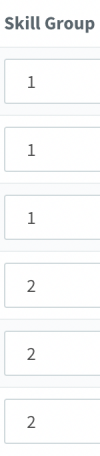
1613216227618.png

I need to do this on around 12 queues, so it would be good to have some kind of solution. Please could someone offer some advise?

Goal: If nobody picks up the phone within 20 seconds, I want them to remain in the same queue (so they keep their queue number) but ring all the phones that are in the office.
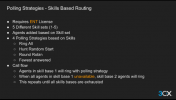
 
edit: this is correct
The routing method is applied to all in skill set 1 and if unavailable then does that routing on the next skill.

edit2: does anyone have any thoughts? That’s actually a great idea/routing method...
 

Attachments

  • BB18F224-A972-426F-BF50-3ECD940EB2C5.png
    BB18F224-A972-426F-BF50-3ECD940EB2C5.png
    29 KB · Views: 29
Last edited:
edit: this is correct
The routing method is applied to all in skill set 1 and if unavailable then does that routing on the next skill.

edit2: does anyone have any thoughts? That’s actually a great idea/routing method...
Yes, it's a neat feature. It needs some trial and error to figure out the best options but it works and does what you need in some way. In your case, I'd go Skill-based Ring All.
 
I wonder if there is a workaround, because I can for sure see the usefulness of ringing all in skill group1 then ring all skill group 2 if no answer in 60 seconds (ring time) for example and continue escalating until timeout (destination -> no answer)

Otherwise, you have to tag it as a lost call and send it up the supervisor chain to a new que. Technically people keep their place in line but... still
 
The way Skill Based Routing works is that a call will stay in the same "Skill Group" while there are agents available.
Available = Idle, so Registered + Logged in + not on a call + not ringing

This means that if some agent in Skill Group 1 has stepped away, an incoming call will ring their extension.
If while ringing, another call comes in, because the extension is "ringing", it will move onto the next Skill Group.
The first call though will stay in Skill Group 1.

As a general rule, when using Skill Based Routing polling strategies, it is a good idea to make sure if agents step away, they are logged out of the Queue to avoid this happening.
 
Skill Based Routing is a great step in the right direction, but it does have some situations where it is not a perfect fit. I have always thought the real solution is to dynamically add more agents into the queue when the total number of callers, or the longest hold times, exceed the SLA thresholds set for the queue. When the numbers fall below the thresholds, you could automatically log out the "overflow" agents.

To do this, you would need an interface where you could "mark" some queue agents as "overflow" agents that are only automatically logged into and out of the queue as needed.

This approach would eliminate the abandoned call issue caused by overflow queues, callers would maintain their position in the queue, there wouldn't be any strange audio artifacts caused by transferring callers to the overflow queues, and the queue reports (like longest hold times) would actually reflect how long a caller waited rather than having to add together the wait times in both queues.

This is all completely feasible using the 3CX Call Control API. If this sounds like something that meets your needs, we can discuss how to get this done.
 
I guess rather than overflow que's, I think what the first poster suggests, and actually what I happen to also be looking for is that skill-based routing rings a skill level for the ring time and then hits the next group.

For example in hunt by 3's it rings the first three for X ring time, then moves to the next 3.

The idea here is the front line people are ready to go, but things happen, they don't answer. If it rings to the higher skill group to ensure that a supervisor can get a call before it hits an SLA.

What is the idea behind the "ring time" then? After 60 seconds, does it just start the ring all to skill 1 again?
 

Attachments

  • Screen Shot 2021-02-17 at 6.13.32 PM.png
    Screen Shot 2021-02-17 at 6.13.32 PM.png
    27.3 KB · Views: 9
What is the idea behind the "ring time" then? After 60 seconds, does it just start the ring all to skill 1 again?
In the "Skill Based - Ring all" polling strategy, the "ring time" will stop ringing everyone in Skill Group X, then start again. Although the benefit of this is not apparent immediately, e.g. if one of your agents as "Ring my mobile simultaneously" enabled, this prevents the call being answered by the Telco's VMail service after 20 seconds, so setting this value lower would prevent this.

In a non Ring all strategy is used, the "ring time" will be the interval at whcih it will move onto the next agent depending on the polling strategy.

We have a more detailed explanation of Queue Polling Strategies in our training material here:
https://www.3cx.com/3cxacademy/videos/advanced/call-queues/

I guess rather than overflow que's, I think what the first poster suggests, and actually what I happen to also be looking for is that skill-based routing rings a skill level for the ring time and then hits the next group.
I understand your point, but this is not how our implementation is.
 
I can't speak for 3CX, but I think it is safe to say they will not make the changes you are requesting anytime soon (if at all). However, I agree it would make the skills based routing more flexible if they made the change you propose. Frankly, you are not the first to make this observation.

So, your options are to: (1) wait and see if 3CX makes this change, (2) live with what is available, (3) look at implementing overflow queues (with their inherit disadvantages), or (4) look at building a custom solution to solve your issue.
 
I can't speak for 3CX, but I think it is safe to say they will not make the changes you are requesting anytime soon (if at all). However, I agree it would make the skills based routing more flexible if they made the change you propose. Frankly, you are not the first to make this observation.

So, your options are to: (1) wait and see if 3CX makes this change, (2) live with what is available, (3) look at implementing overflow queues (with their inherit disadvantages), or (4) look at building a custom solution to solve your issue.
Option 5: change software completely.
 
Well TBH I like NickD's comment that you can do ring-time for the skill to avoid cell-phone auto-answer. That is actually quite smart/good. I can see that being used at some point because of the internet issues in the US.

Every PBX will have limits and features, becoming an expert in 3CX allows you to quickly make workarounds. Here I guess the answer is either explaining how it works to customers or using overflow. It isn't a terrible idea. Especially if you have a larger wrap-up time.
 
  • Like
Reactions: NickD_3CX
I think overflow queues are (or should be) universally hated due to all the negative side effects, but there really is no other option out-of-the-box. That's my opinion, but then I make a living building custom solutions so perhaps I have a strong bias :).
 
Status
Not open for further replies.