

The 15 Best Call Center Software Options for 2025
Choosing the right call center software is not just a tech upgrade. It's a core business decision. In 2025, companies need flexible, cost-effective platforms to handle conversations across voice, email, chat, and social media. The best solutions now support full contact center capabilities and cloud telephony to keep teams responsive and efficient.
For IT managers and business owners at SMBs and enterprises, the right platform improves productivity, supports growth, and boosts customer satisfaction. With so many providers, it's important to focus on benefits like automatic call distribution, call recording, and real-time analytics.
Key Features to Look for in Software for Calling Center
Let's break down the important aspects of contact center solutions in the modern age.
Omnichannel Contact Center Capabilities
Modern tools let agents manage voice, chat, SMS, and also social media from one interface. This helps teams stay organized and respond consistently across all channels.
Automatic Call Distribution and IVR
Call routing features direct callers to the right person based on skill, department, or even location. IVR menus help customers get answers faster and reduce pressure on live agents.
CRM Integration for Smarter Conversations
Integrated CRMs let agents see caller history and preferences instantly. This reduces repeat questions and helps deliver more personal, effective service.
Scalability and Flexibility
Choose a solution that grows with your team. Look for support for higher call volumes, more users, and the ability to adjust as your needs change.
Clear and Cost-Effective Pricing
Some systems charge per user, others per concurrent call. Understand what fits your business model to avoid paying for more than you need.
Call Center Analytics and Reporting
Track agent activity, call volume, resolution time, and customer satisfaction. These insights help improve staffing, training, and processes.
Security and Compliance
Strong data protection is a must. Look for encryption, access controls, and compliance with GDPR, or similar laws.

Top 15 Call Center Solution (2025)
Without further ado, let's get into our top picks for call center software in 2025.
1. 3CX
Best Overall Call Center Software for 2025
3CX is the top-ranked platform for 2025. It delivers complete contact center functionality, advanced call handling, and full control over how and where it runs. Unlike other solutions, 3CX does not lock you into high per-user pricing or third-party hosting.
Built for SMBs and large enterprises alike, 3CX is the most cost-effective option available. Its pricing is based on concurrent calls, not seats, so it helps teams of any size reduce costs while scaling up with confidence.
3CX leads the pack for 2025 as a flexible and cost-effective contact center platform. Designed for SMBs and enterprises, 3CX is built to scale with your business. It supports both cloud and on-premises deployments and avoids per-user fees by pricing based on concurrent calls.
Why 3CX is the Market Leader
Omnichannel contact center: Voice, video, SMS, email, and social media in one interface
Automatic call distribution: Skills-based routing and priority queues
IVR tools: Custom call flows to reduce wait times
CRM integration: Sync with Salesforce, Zoho, HubSpot, and others
Call recording: For quality monitoring and compliance
Cloud telephony: Self-host or use Amazon, Azure, or Google Cloud
AI tools: Includes transcription and smart call routing
3CX offers more flexibility, control, and value than any other call center solution. It gives businesses the tools to support customers across every channel while keeping costs low and performance high. No other platform combines this level of power and affordability.
-Peter McIntyre, Practice Manager at NHS Vesper Road

2. Zendesk
Zendesk is a widely recognized call center solution and its known for its focus on delivering exceptional text-based and support-oriented communication. Designed to simplify customer service operations, Zendesk is ideal for businesses seeking a platform that prioritizes customer interaction through email, live chat, and social media channels. Its intuitive interface and robust functionality make it a preferred choice for small to medium-sized businesses (SMBs) and enterprises.
Zendesk offers a cloud-based platform, allowing businesses to have a unified system for managing customer support. Key features include automated ticketing, real-time updates, and a powerful reporting dashboard. With omnichannel support, agents can engage with customers across various communication channels without losing context, leading to improved customer satisfaction and retention.
A highlight of Zendesk is its ability to manage text-based communication efficiently. The platform excels in providing tools for handling customer inquiries, troubleshooting issues, and delivering consistent support experiences across email, chat, and messaging apps.
While Zendesk is a strong choice for support-oriented communication, its reliance on ticketing workflows can sometimes feel rigid for businesses needing more flexible call management solutions. In addition, voice-based support features are less thorough compared to platforms like 3CX, making Zendesk less ideal for businesses with a heavy emphasis on telephony.
3. Dialpad
Dialpad stands out as an AI-driven call center software solution, offering innovative features that enhance communication efficiency and productivity. Targeted at SMBs and enterprises, Dialpad is particularly well-suited for businesses seeking advanced AI tools to streamline operations and improve customer interactions.
One of Dialpad’s most impressive features is its AI-powered call routing, which ensures that incoming calls are directed to the right agent based on predefined criteria, such as expertise or availability. This functionality reduces response times and improves customer satisfaction. Also, Dialpad offers real-time transcription powered by AI, providing businesses with accurate and immediate documentation of customer conversations. This feature is invaluable for training, compliance, and identifying actionable insights from customer feedback.
Dialpad excels in leveraging AI for enhanced communication, its focus on AI features can sometimes overshadow traditional call center tools. For businesses that rely heavily on more straightforward telephony systems or need extensive CRM integrations, Dialpad might feel limited. Moreover, its pricing structure can be less flexible than alternatives like 3CX, making it less appealing to cost-sensitive organizations.
Despite these limitations, Dialpad remains a strong contender for businesses that prioritize cutting-edge AI features in their call center operations.
4. Nextiva
Nextiva is a cloud-based call center software solution designed to meet the needs of growing businesses. Known for its reporting and analytics tools, Nextiva empowers IT managers and decision-makers to make data-driven decisions, improving efficiency and customer service. Its user-friendly interface and scalability make it a preferred choice for businesses looking to expand.
Nextiva provides a comprehensive suite of analytics features, offering insights into call volumes, agent performance, and customer satisfaction. These tools allow businesses to track metrics in real time, identify areas for improvement, and streamline workflows. With its cloud-based architecture, Nextiva ensures reliability and accessibility, enabling businesses to manage communications from anywhere, whether in-office or remote.
While Nextiva excels in analytics and scalability, its integration capabilities can fall short for businesses with complex CRM requirements. Some users have noted that its integrations with third-party tools lack the depth and flexibility offered by competitors. This could limit the platform’s ability to adapt seamlessly to diverse business ecosystems, especially for larger enterprises.
Regardless, Nextiva remains an excellent choice for growing businesses that value intuitive software with powerful analytics. Its focus on cloud-based solutions makes it a strong contender in the call center software space.
5. Aircall
Aircall brings simplicity and efficiency to call center operations, making it an excellent choice for businesses prioritizing voice communication. Its cloud-based platform emphasizes traditional call center functionality while integrating with popular productivity tools to support smooth workflows. This focus on voice-driven solutions makes Aircall stand out in a crowded market.
With a suite of features designed for voice-focused teams, Aircall ensures that its system for managing calls is as natural as possible. Tools like call monitoring, call tagging, and click-to-dial empower agents to handle high call volumes effectively. Its integrations with platforms like Salesforce, HubSpot, and Slack further enhance productivity by centralizing essential information and simplifying collaboration.
Aircall’s voice-first approach appeals to traditional call centers, but its limited support for other channels, such as email or chat, can be a disadvantage for businesses seeking a broader omnichannel solution. Also, its pricing model may not suit smaller teams, as costs rise significantly with team size and feature add-ons.
6. Five9
Five9 is a highly effective cloud-based call center solution known for its focus on automatic call routing and handling high call volumes. While it’s a powerful platform, some users report challenges with its steep learning curve and occasional technical glitches that can disrupt operations. Furthermore, the pricing structure may feel restrictive for smaller businesses with tighter budgets.
Designed with scalability in mind, Five9 excels in supporting call centers that manage a large number of interactions daily. Its automatic call routing system ensures customers are directed to the right agent quickly, optimizing response times and enhancing customer satisfaction. For teams dealing with constant high call traffic, these features are invaluable.
Five9’s cloud-based architecture provides flexibility and accessibility, allowing teams to operate efficiently from any location. Its integration capabilities with CRM systems like Salesforce streamline workflows and offer agents real-time access to essential customer data. The advanced reporting tools further empower businesses to track key performance metrics and continuously improve service quality.
7. Freshdesk
Freshdesk has carved a niche in the call center software market as a solution that prioritizes customer support. Its focus on seamless CRM integration and high customizability makes it a reliable option for businesses looking to enhance their customer service capabilities. Designed with user experience in mind, Freshdesk is particularly suited for SMBs and enterprises that prioritize customer interaction.
Freshdesk’s ability to integrate effortlessly with popular CRM platforms allows businesses to access customer data instantly, ensuring personalized and efficient communication. The software’s customizability means businesses can tailor workflows, ticketing systems, and communication processes to suit their unique needs. This level of flexibility makes Freshdesk a top contender for customer support-driven organizations.
However, while Freshdesk may may not be the best fit for businesses requiring robust voice communication tools, it remains strong in email and chat. While excellent for email and chat, its telephony features lack the depth and reliability offered by 3CX. Scaling Freshdesk for larger teams can lead to higher costs, which may deter budget-conscious businesses.
While Freshdesk is a strong option for companies focusing on customer support, businesses seeking a more versatile, cost-effective communication platform may find 3CX a superior alternative.
8. LiveAgent
LiveAgent is a versatile platform built to handle diverse customer service needs, but its real strength lies in text-based support. As an all-in-one customer service tool, it simplifies the process of managing inquiries across email, live chat, and social media. This makes it an excellent choice for businesses focused on delivering fast, efficient written communication.
The ticketing system in LiveAgent centralizes all customer queries into one dashboard, helping teams stay organized and responsive. Whether it’s resolving a live chat issue, replying to a tweet, or following up on an email, agents can tackle tasks efficiently without jumping between platforms. This streamlined approach saves time and ensures a smoother customer experience.
For businesses needing a range of voice capabilities, LiveAgent’s offerings may feel limited. Unlike Five9, which specializes in call routing and handling high call volumes, LiveAgent’s voice tools lack depth. Scaling up with LiveAgent can become pricey for larger teams, as the cost increases with advanced features and additional users.
9. CloudTalk
CloudTalk is a dynamic call center software solution built for businesses with global operations. Its features cater to organizations that need international calling and advanced analytics to monitor and improve their communication processes. For SMBs and enterprises aiming to serve international markets, CloudTalk delivers a reliable, cloud-based platform.
While CloudTalk excels in international calling, 3CX goes a step further by offering unparalleled scalability and flexibility for global operations. With its ability to self-host or integrate with cloud providers like Amazon and Azure, 3CX ensures businesses have complete control over their communication infrastructure, no matter where they operate. 3CX’s cost-effective pricing model based on concurrent calls offers significant savings for businesses managing international teams.
CloudTalk is a strong contender for companies prioritizing analytics and international reach. However, for organizations seeking greater flexibility and comprehensive communication tools, 3CX remains the more versatile solution.
10. Talkdesk
Talkdesk is a powerful, scalable cloud solution that integrates cutting-edge AI tools to streamline call center operations. It stands out for its customization options and robust omnichannel support. Whether managing voice calls, chat, or email, Talkdesk ensures a consistent, high-quality experience for businesses and customers alike.
Talkdesk harnesses AI to enhance efficiency and optimize workflows. Features like automated call routing, predictive analytics, and real-time agent assistance empower teams to provide faster and more personalized service. Its scalability makes it an ideal choice for businesses looking to expand their call center capabilities without overhauling their infrastructure.
While both Talkdesk and Dialpad incorporate AI, their approaches differ. Dialpad focuses on real-time transcription and sentiment analysis to improve agent performance, whereas Talkdesk excels in providing end-to-end customization and a broader range of omnichannel tools. Businesses needing a more tailored solution with extensive communication options may find Talkdesk a better fit.
11. Avaya
Avaya has long been a staple in the call center industry, recognized for its reliable on-premises solutions. Designed with enterprise-level operations in mind, it’s particularly well-suited for companies already utilizing Avaya systems, offering smooth integration and dependable performance.
On-premises infrastructure is built for stability and high-volume inbound and outbound calls. Its comprehensive suite of tools, including advanced IVR capabilities and workforce management, enables businesses to maintain efficient and effective communication. For enterprises that prioritize control over their communication systems, Avaya delivers a robust and secure option, ideal for maintaining operations without disruption.
On the flip side, Avaya’s dependency on physical infrastructure may be less appealing to businesses seeking flexibility. Scaling operations often requires costly hardware upgrades, making it less adaptable than cloud-based options.
12. HappyFox
HappyFox is a versatile call center solution that shines with its user-friendly interface and CRM integration. Tailored for small to medium-sized businesses (SMBs), it offers a straightforward approach to managing customer interactions, making it an excellent option for teams looking for simplicity without sacrificing efficiency.
HappyFox is designed to streamline customer service operations, offering features like ticket management, live chat, and call tracking. Its integration capabilities with popular CRMs ensure agents have immediate access to customer data, enabling more personalized and effective communication. The intuitive interface reduces the learning curve, allowing teams to quickly adapt and focus on delivering great customer experiences.
While HappyFox excels for SMBs, it may fall short for larger enterprises with complex needs. Its scalability is limited, making it less suited for organizations with high call volumes or diverse communication channels. Moreover, the platform’s advanced features can lead to higher costs, which might not align with the budget of larger teams.
13. UJET
UJET is a modern call center software solution known for its strong focus on mobile integration. Designed to enhance customer experiences, it excels in managing high call volumes, particularly for businesses with mobile-first customers. With an emphasis on seamless app-based communication, UJET is a great fit for SMBs and enterprises seeking to elevate their mobile customer support.
The standout feature is certainly its ability to integrate directly with mobile apps, enabling customers to communicate via voice, chat, or multimedia within a single platform. This simplifies the user experience while reducing call resolution times. UJET also offers advanced features like real-time data sharing and customer authentication, which improve efficiency and boost customer satisfaction.
While UJET is highly effective for mobile-centric businesses, it has some drawbacks. Its features are heavily geared toward mobile integration, which may leave traditional desktop-based teams underserved. Finally, its pricing model can be a hurdle for smaller businesses, as it often skews higher than competitors like 3CX.
14. Bitrix24
Combining cutting-edge CRM capabilities with call center features, Bitrix24 is an all-in-one platform for businesses seeking streamlined communication and customer management. It is particularly appealing to SMBs and enterprises that require integration between their customer relationship management and call center operations.
Bitrix24 is noted for its ability to centralize customer data, track interactions, and provide real-time insights. These CRM features integrate effortlessly with its call center tools, enabling teams to handle inquiries, manage sales pipelines, and improve customer satisfaction from a single platform. The software also offers omnichannel support, covering phone calls, emails, and social media, which makes it versatile for businesses operating across multiple communication channels.
While Bitrix24 offers a lot of value, it’s not without its limitations. For larger teams or businesses with high call volumes, the platform’s interface can feel cluttered and less intuitive, potentially slowing down operations.
15. RingCentral
RingCentral is a widely recognized call center software solution, offering features that cater to businesses of all sizes. Prized for its cloud-based infrastructure and extensive integrations, RingCentral is particularly effective for teams looking for a unified communication platform.
As a fantastic example of omnichannel support, RingCentral allows businesses to manage voice calls, video conferencing, messaging, and social media interactions within one platform. Its integration capabilities with popular tools like Salesforce and Microsoft Teams further enhance productivity and collaboration. For businesses prioritizing flexibility, RingCentral provides a scalable solution that adapts to changing needs.
However, RingCentral’s pricing can be a significant drawback. The platform charges on a per-user basis, which can quickly escalate costs for growing teams.
How to Choose the Best Software for Calling Center
Now we've broken down the top 15 options for 2025, let's look at how you can decide on the call center software for your business.
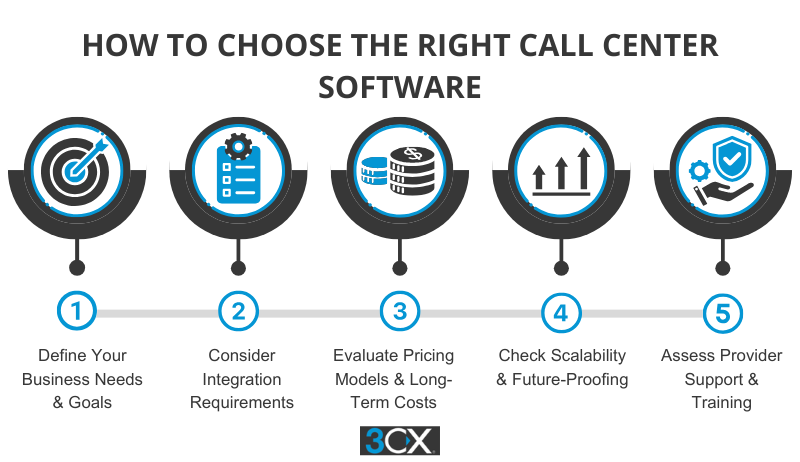
1. Define Your Business Needs and Goals
Start by assessing your specific requirements.
Are you primarily handling inbound calls or outbound calls?
Determining whether your business focuses on inbound or outbound calls is essential for choosing the right call center software. Inbound calls are common in customer service departments and tech support teams, where customers initiate contact for assistance. Outbound calls are prevalent in sales and telemarketing, where teams actively reach out to prospects. Many businesses, such as healthcare providers or financial services, handle both, requiring versatile solutions that support instant communication across all types of interactions.
Do you need omnichannel capabilities or a platform optimized for voice communication?
Identify key goals, such as improving customer experience, enhancing agent productivity, or reducing operational costs. By understanding your priorities, you can narrow down options and focus on software that aligns with your objectives. For example, SMBs might prioritize cost-effectiveness and user-friendly features, while enterprises may look for advanced analytics and scalability.
2. Consider Integration Requirements
Ensure that the software integrates with your existing tools and systems, such as CRM platforms, help desks, or productivity apps. Integration enhances workflow efficiency by consolidating customer data and enabling agents to access vital information quickly. If your business relies heavily on specific tools, look for software like 3CX, which offers comprehensive integration options to streamline operations and improve communication.
3. Evaluate Pricing Models and Long-Term Costs
Budget is a key consideration. Review the pricing structures of potential software solutions—whether they charge per user, per call, or a flat annual fee. Consider hidden costs, such as setup, maintenance, or premium feature fees. A cost-effective model based on concurrent calls can be a game-changer for businesses aiming to reduce expenses without compromising on quality. Choose a solution that provides transparency and value for your investment.
4. Check Scalability and Future-Proofing
Your call center needs today may not reflect your requirements in the future. Select software that grows with your business. Look for scalable features, such as the ability to add users, support higher call volumes, or expand to new communication channels. Cloud-based solutions are particularly advantageous, as they allow businesses to adapt quickly to changing demands while maintaining high performance.
5. Assess Provider Support and Training
Even the most advanced software can fall short if it doesn’t come with reliable support and training. Evaluate the provider’s customer service options, such as availability, onboarding assistance, or dedicated account managers. Ensure your team has access to comprehensive training resources, such as tutorials, documentation, or webinars.
Making the Right Decision
Choosing the right call center software is about finding a solution that aligns with your current needs while preparing you for future growth. By defining your goals, evaluating integration and pricing, and ensuring scalability and support, you’ll be well-equipped to invest in software that drives efficiency and customer satisfaction. Following these steps will not only simplify the selection process but also set your business up for long-term success.
Try 3CX for Free
Discover why 3CX is the leading call center software for 2025 with a free trial that lets you explore its powerful features. Designed for SMBs and larger enterprises, 3CX offers:
- Cost-effective annual licensing with no per-user charges, ensuring maximum value.
- Easy migration from legacy systems like Avaya and Mitel, saving time and resources.
- Full control over phone numbers and call trunks for a tailored communication infrastructure.
- Future-ready features, including AI-powered call routing for optimized customer interactions and agent performance.
- Scalability, supporting both local teams and global operations seamlessly.
3CX is perfect for businesses looking to reduce costs, streamline communication, and future-proof their operations. With its user-friendly interface and innovative tools, 3CX allows businesses to simplify, scale, and stay ahead in the ever-evolving call center space.
Try 3CX today and experience how it can transform your communication strategy. Start your free trial now!
Your Questions Answered…
Further reading
Last Updated
This document was last updated on 4 July 2025
https://www.3cx.com/pbx/call-center-software/

 Copyright © 2026