What is a Cloud Contact Center?
A cloud contact center, also known as a cloud call center, is a web-based communications platform that handles customer communications. Whereas ‘call centers' traditionally focus on inbound and outbound calls alone, ‘contact centers' support a multichannel environment which typically comprises phone calls, live chat, social media messaging, texting and video. It also has integration capabilities with other business systems such as ERP, CRM, eCommerce, accounting, etc.
How does a cloud contact center work?
A cloud-based contact center solution is hosted in the cloud and can be accessed from anywhere with an active internet connection. It is the ideal solution for companies spread across a number of geographic locations or with agents working remotely.
Unlike traditional on-premise call centers, a cloud-based call center doesn't require expensive telecom equipment to purchase and maintain. Instead, it relies upon IP telephony technology to establish voice connections through the internet.
All other digital channels, such as social media messages or live chat, are easily connected. Everything is managed centrally from the cloud-based contact center dashboard making for a truly omnichannel solution. All customer interactions are linked to an account and assigned a specific agent or group of agents. It can also sync data with your customer relationship management (CRM) software in the background, ensuring every customer interaction and customer contact is readily available.
Since a cloud hosted contact center operates entirely online, you only need to provide computers, headsets, and an Internet service for your team. Agents simply log into the system to pick up incoming calls or chats, allowing customers to communicate in real-time via their preferred channel.
Why should I move my contact center to the cloud?
Making the switch can significantly improve the customer experience as well as speeding up resolution of customer issues. It also lowers overheads and increases scalability, as there is no need for physical infrastructure. Customers are looking to communicate with businesses and service providers in more ways than ever before, so you need a solution that's as dynamic and flexible as your business is expected to be. Traditional on-premise contact centers are less flexible and not readily available for remote workers. They also lack the feature set offered by cloud contact center platforms.
Benefits of a cloud-based contact center
Opting for a contact center in the cloud comes with numerous advantages:
Increased scalability – Continually meet the needs of your evolving business and increase the number of users in an instant.
Cost saving – With no premise hardware and minimal maintenance required, you'll significantly reduce your operational costs.
Faster deployment – A cloud contact center solution can be operational in less than an hour, so you don't need to press pause on business during your migration.
Flexibility – Agents can work from the office, remotely or from work from home with ease.
Increased productivity – Cloud platforms offer one user friendly platform for all communication channels, so your qualified agents can focus on conversations not admin.
Customer satisfaction – With a suite of tools easily integrated into the cloud solution, customers have more ways to communicate that just phone calls.
How to choose the best cloud contact center provider
By moving your call center to the cloud, you're already going to benefit from the increased flexibility, additional capabilities and lower running costs. To maximize the benefits to your business, make sure to choose a provider whose software solution is robust, reliable and secure and who can offer a comprehensive suite of integrated features.
Here are some key features to look out for in cloud contact center providers:
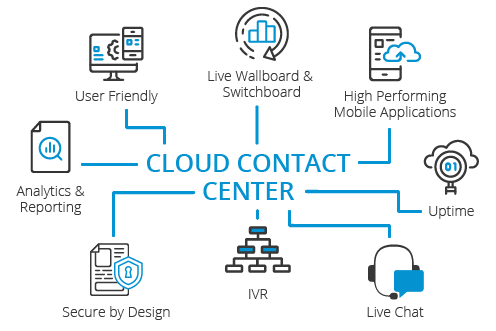
User friendly web interface – Look for cloud contact center software that has a user intuitive interface to increase agent productivity. After all, you want your agents to focus on providing top quality customer service rather than being bogged down by usability issues and complicated training.
Live Wallboard and Switchboard – The beauty of a cloud contact center platform lies in the additional functionality it can bring to your business. One of the major benefits is increased accuracy with real time reporting, so look for comprehensive wallboards and switchboards that have built-in training functions, such as listen and barge in.
Mobile applications – Center managers and agents alike will benefit from fully integrated mobile applications that enable them to communicate while on the move. Make sure the mobile phone apps support chat and conferencing too.
Uptime – If you want to provide outstanding customer service you need a way to monitor system and agent performance. Cloud contact centers should include a call reporting module for performance management, quality management and agent efficiency. These typically include reports on average call duration, idle time and queue callbacks.
Live chat and messaging – 90% of consumers would now rather send a message than call. Communicate on their terms with an integrated live chat service that lets you connect with visitors to your site or social media in real time.
ACD – You don't want your agents to burn out. By using Automatic Call Distributors (ACD), you can route calls or chats accordingly, to the right agent. This is done either through skill-based routing, or by using a series of polling strategies that ensure idle agents or ones with least talk times get that call.
IVR – Your Interactive Voice Response (IVR) is the backbone of your contact center. Make sure you can create menus, and greetings and continually alter your call flows to improve the contact center experience. Some IVRs also include advanced features and artificial intelligence such as Natural Language Processing (NLP) to support and detect multiple languages.
Analytics and Reporting tools – If you want to provide outstanding customer service you need a way to monitor system and agent performance. Cloud platforms should include a call reporting module for performance management, quality management and agent efficiency. These typically include reports on average call duration, idle time and queue callbacks.
Secure by design – During discussions with vendors ask how they're protecting your data and prioritizing security as an organization. Calls should be encrypted via HTTPS / DTLS / WebRTC, passwords and URLs should be randomly generated and malicious IPs should be blacklisted by default.
3CX cloud contact center solution
The 3CX cloud-based contact center solution is designed to meet modern business needs, providing a comprehensive and flexible option. It’s easy to integrate into leading CRMs like Zoho, Salesforce, and Hubspot and includes everything you need from a contact or call center in the cloud.
Here’s a look into what you can expect from our contact center cloud solution.
One of the standout features of 3CX is its value. Unlike other solutions, 3CX doesn’t charge per agent. Everyone in your company can help answer customer calls, messages, and chats - without any extra costs.
3CX enables efficient management of your cloud-based contact center. With detailed call and chat reports, it’s easy to monitor performance and ensure targets are being met. Features like login history and call/chat statistics also allow for transparent tracking of daily operations.
Take advantage of an advanced contact center cloud solution with 3CX. IVR menus are easy to set up and skill-based routing and round-robin queue strategies help ensure that calls are directed to the right agents.
Find what else our cloud contact center software offers.
Cloud Contact Center FAQ's
We’ve answered the questions we get asked most frequently about cloud contact centers in the section below.
The difference between a cloud contact center and a hosted contact center is that a cloud contact center operates entirely over the internet, with all services and infrastructure stored and managed in the cloud. This means there’s no need for on-premise hardware, making it easier to expand and update your system. A hosted contact center refers to a contact center managed by a third party provider, which can be stored on the cloud or on a physical server.
Yes, cloud computing is highly effective in managing customer contacts. By using cloud technology, businesses can handle all customer interactions—calls, chats, emails, and more—on a single platform. It provides real-time data, tracks communication history, and integrates with CRM systems, allowing businesses to offer personalized and efficient customer service.
A cloud call center routes calls through the internet rather than traditional phone lines. This is made possible with a cloud based call center solution like 3CX, which manages incoming and outgoing calls via VoIP (Voice over Internet Protocol). Calls are directed through data centers, and the system uses intelligent routing to ensure they reach the right agent.
Further reading
Last Updated
This document was last updated on 4 July 2025
https://www.3cx.com/pbx/cloud-contact-center/



 Copyright © 2026